
From boundary to bankable layout
Automatic layouts with real setbacks, grading and stringing, and 8760 hourly yield with shading on the design you will actually build.
Updated October 2026
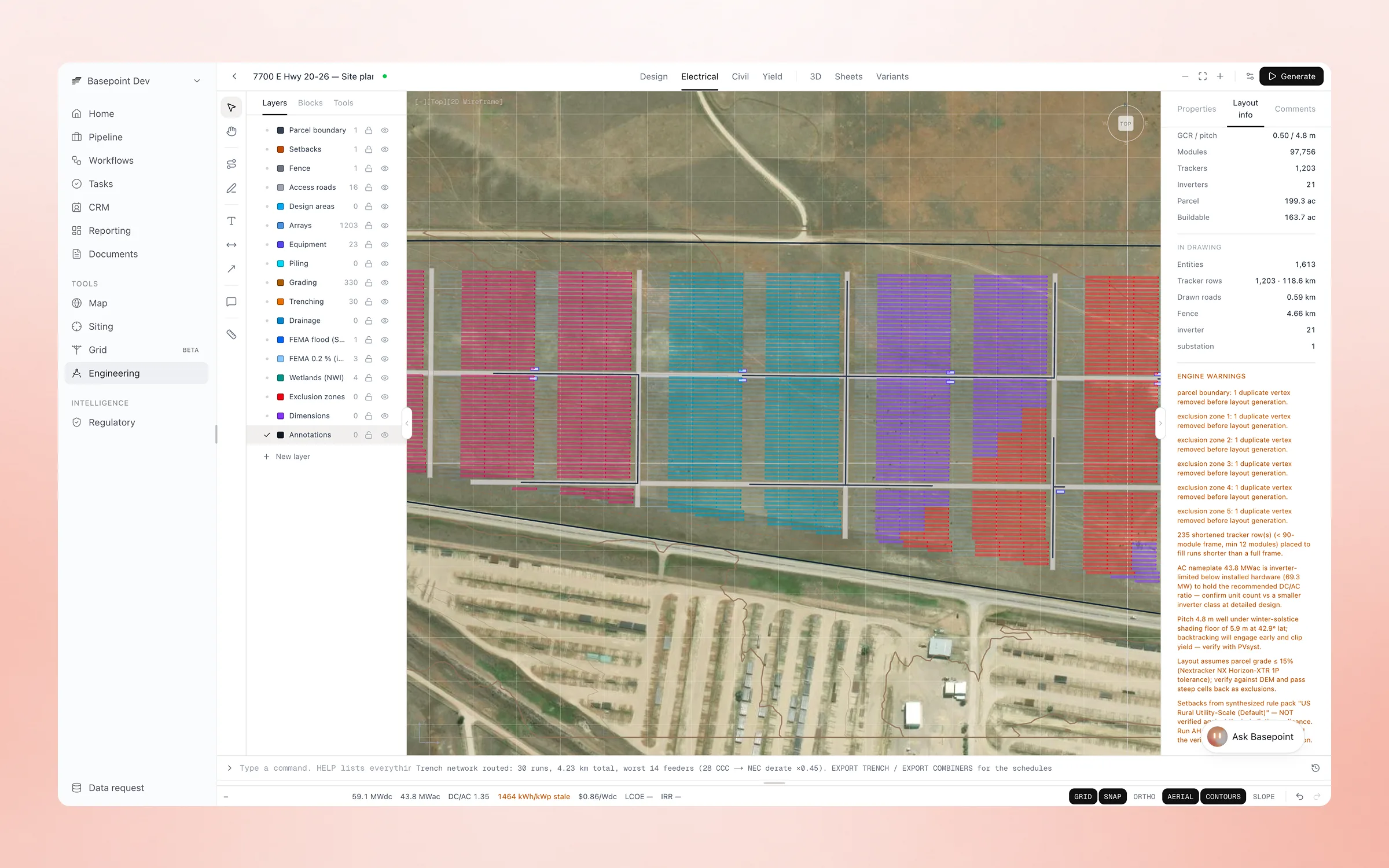
The layout that carries through to the model
Draw or import a boundary and CAD Studio generates a layout on the real parcel. The electrical, civil, and yield work then runs on that same drawing.
Layout on the actual boundary
Setbacks come from the local ordinance, exclusions from wetlands, floodplain, and slope. Trackers, modules, and inverters are placed inside what remains, and the layout panel reports ground coverage ratio, module count, trackers, inverters, and buildable acres as the design changes.
Electrical follows the layout
String blocks, combiner assignments, inverter blocks, and trench routing are generated from the drawing itself, around the roads and substation already in it. Change the layout and the electrical design regenerates.
Civil on the real terrain
Contours, slope heatmaps, grading design, road grade checks, pile length bins, and drainage screening run on the elevation model under the parcel. Piling is generated to match, and the surface exports as LandXML when civil takes over.
Yield and warnings you can act on
Shading analysis and an hourly energy model run on the design as drawn. Engine warnings call out shortened rows, inverter-limited AC nameplate, and pitch below the winter shading floor, so the number that reaches the financial model is one an engineer would sign.
Frequently asked questions
How accurate are the automatic layouts?
Layouts use jurisdiction-specific setbacks, real terrain, and a component database, and export to DXF, DWG, and PVsyst so engineering can validate and refine them in existing tools.
Can I model trackers and fixed tilt?
Yes. Racking and equipment selection covers common utility-scale configurations, and yield runs against the selected design.
What does 8760 modeling mean?
An 8760 model simulates production for every hour of the year, which is what revenue modeling and financing partners need, rather than a single annual estimate.